
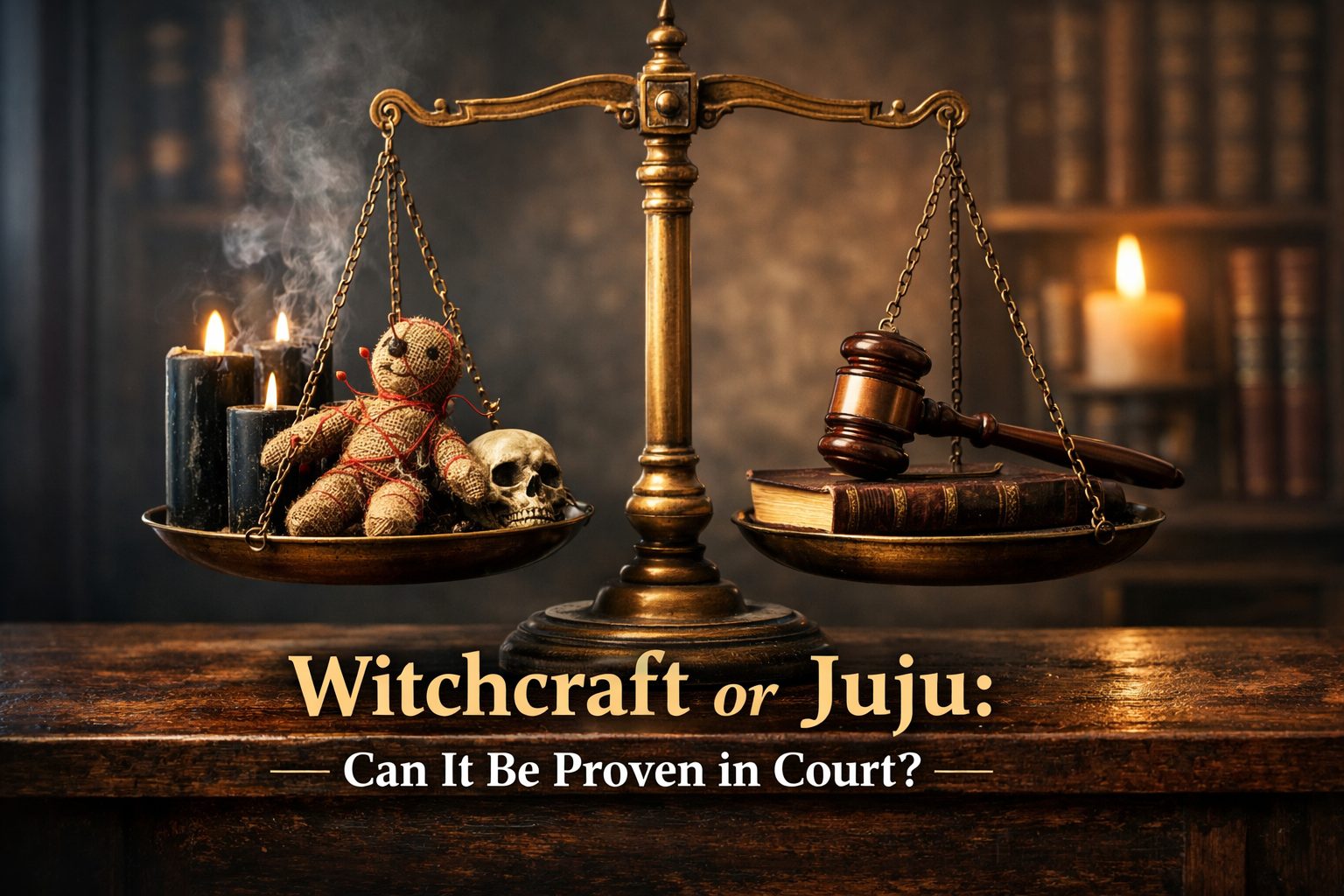
Belief in witchcraft or juju is deeply rooted in many cultures, particularly across Africa. Despite its social and spiritual significance, modern courts do not recognize witchcraft as a supernatural fact. Instead, the law focuses strictly on verifiable actions and legally admissible evidence.
Is Witchcraft or Juju a Crime?
In most common-law jurisdictions, including Nigeria, the United Kingdom, and the United States, witchcraft or juju itself is not a crime. However, the law criminalizes acts connected to such beliefs, including:
- Fraud and obtaining money by false pretence
- Threats, intimidation, and coercion
- Assault or murder arising from witchcraft accusations
- Defamation and harassment
How Can Witchcraft or Juju Be Proven in Court?
Courts do not accept spiritual claims as proof. Any case involving witchcraft must be established using objective and physical evidence, such as:
- Confessions – Must be voluntary and lawfully obtained
- Observable conduct – Threats, harmful rituals, or coercive acts
- Physical evidence – Documents, money trails, weapons, injuries
- Witness testimony – Limited to facts personally seen or heard
- Expert evidence – Used only to explain cultural context, not supernatural power
Legal Cases and Examples
R v. Chilton (UK): The court rejected witchcraft claims but upheld a conviction based on fraudulent practices.
Nigerian Courts: Courts have consistently held that witchcraft is not provable, but crimes arising from accusations are punishable under criminal law.
Salem Witch Trials (1692, USA): Often cited as a historical warning against allowing superstition and fear to replace evidence in legal proceedings.
Key Legal Principle
Courts deal with facts and proof, not fear or belief.
Conclusion
While belief in witchcraft or juju remains culturally significant, legal liability arises only from tangible criminal acts. Without physical and credible evidence, allegations of witchcraft cannot succeed in court.
Legal Disclaimer: This article summarises public law sources and reported cases for general information only. It is not legal advice. For case-specific guidance, consult a qualified Nigerian lawyer.